
Longevity Starts With Healthy Blood Flow.
Understand your circulation. Support your vascular health. Build your personal prevention plan.
Living longer is only half the goal. The other half is staying active: walking the beach, traveling, riding, playing with your grandchildren. All of that depends on healthy blood flow to your brain, your heart and your legs.
Most vascular problems build quietly for years before they cause pain. A narrowed artery in the neck, a bulge in the aorta, or poor circulation in the legs can be present with no warning sign at all. Finding them early is one of the simplest things you can do for your long-term health.
FlowState is our vascular longevity program. It works in three steps: understand your circulation, improve it with a plan built for you, and reassess to see what is working. You do not need symptoms to start. That is the point.
FlowState is led by Dr. Kristian A. Ulloa, a quadruple board-certified vascular surgeon and the only vascular surgeon in the United States board-certified in general surgery, vascular surgery, wound care, and holistic and integrative health.
Most vascular practices are built around procedures: they see you once something has gone wrong. Dr. Ulloa’s training in holistic and integrative health means he also looks at what drives vascular disease in the first place, including blood sugar, inflammation, nutrition and activity, alongside conventional vascular care.
This is not alternative medicine. It is prevention held to the same evidence-based standard as the rest of our care.
Three painless ultrasound and blood pressure studies check the places where silent vascular disease most often hides. No needles, no radiation, no hospital visit.
Screening for people without symptoms is generally not covered by insurance, so this is a self-pay visit.

Leg veins are checked separately in our Leg Vein Evaluation: a visit with a vascular surgeon plus a vein valve ultrasound, $199 self-pay. It is the right choice for varicose or spider veins and heavy, aching legs. Planning a long trip? See Before a Long Trip below.
A normal screening is good news, but no single test shows everything about your circulation or predicts the future. That is why FlowState is a plan, not a one-time scan.
The core screening is the starting point. If one of these describes you, tell us when you book so your FlowState plan covers what matters for you. You don’t need symptoms for any of them. We are adding more FlowState services over the coming months.

For: long flights (4 hours or more) and long drives, including the seasonal drive to and from Florida.
Sitting still for hours slows blood flow in the legs. A long flight roughly doubles the chance of a blood clot in the leg, though the overall risk is still low: about 1 in 4,600 flights. The risk is higher if you have had a clot before, recent surgery, cancer, or varicose veins, or take estrogen.
For travelers, your FlowState plan covers your clot risk factors, whether compression stockings make sense for you after we check your leg circulation, and a plan for the trip: when to walk, seat exercises, drinking enough water, and what to watch for after you land.
If you develop chest pain or sudden shortness of breath during or after travel, call 911.

For: riders, runners, triathletes, swimmers, rowers, and anyone who trains hard.
A few circulation problems show up mainly in fit, active people and are easy to mistake for a muscle problem:
These problems often show up only during exercise, so a test done at rest can miss them. Tell us about your sport and training when you book.

For: nurses, teachers, hairstylists, chefs, and anyone in retail or hospitality who stands most of the day.
Years of standing put steady pressure on the valves in your leg veins, which can lead to aching, swelling and varicose veins. Our Leg Vein Evaluation, a surgeon visit with a vein valve ultrasound, shows whether your valves are holding up. Link: “Learn about leg vein care” to the Varicose Veins condition page.

For: anyone whose parent, brother or sister had an aortic aneurysm, a stroke, early heart disease, a blood clot or serious leg circulation problems, and anyone told they carry an inherited risk.
Some vascular conditions run in families. Brothers, sisters and children of people with an aortic aneurysm have a higher chance of having one themselves. You can’t change your genes, but you can find problems early and recheck on a schedule.
The FlowState Advanced Risk Panel adds blood work that goes beyond a standard checkup: ApoB, lipoprotein(a), hemoglobin A1C, fasting insulin and hs-CRP. Lipoprotein(a) is inherited, and experts recommend every adult have it measured at least once. When your family history points to a specific inherited condition, we refer you to a genetics specialist.
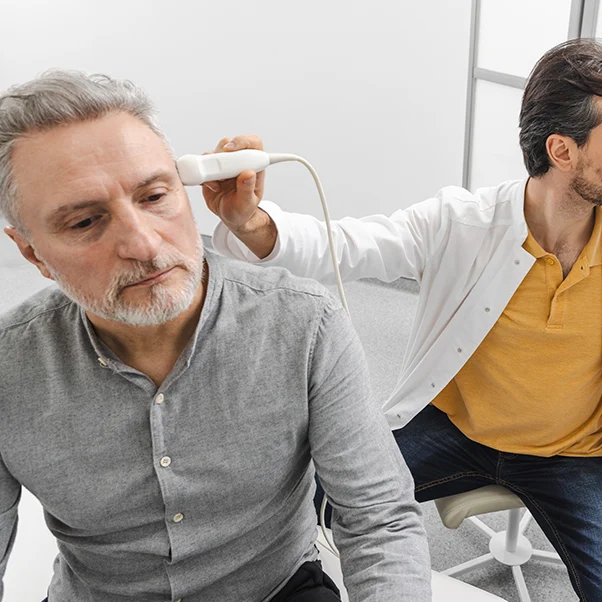
For: anyone who wants a baseline picture of blood flow out of the brain, including people who sit at a desk or screen for long hours.
The large veins in the neck carry blood away from the brain. Their shape changes with head and neck position, and in some people a bone or muscle presses on one of them. A neck vein ultrasound looks at that flow with your head in different positions.
If we find narrowing, your physician explains what it means for you and whether a referral makes sense.
If you have a whooshing sound in the ear that beats with your pulse, headaches that change with head position, or changes in your vision, a physician evaluates you first rather than relying on ultrasound alone.
Sudden weakness, a sudden severe headache or sudden vision loss is an emergency. Call 911.
Anyone can schedule a FlowState screening without a referral. We especially recommend it if you have any of these:
If you already have symptoms, such as leg cramping when you walk, a cold or numb foot, or a sore that is slow to heal, we will see you for a medical visit instead, billed to your insurance in the usual way.
FlowState guidance focuses on five areas:
Screenings are available at both offices, and we will get you in as quickly as possible.